
65 SEO Statistics 2026 (Market Size, Trends & Insights)

Google performs over five trillion searches annually. And search engine optimization is still the biggest contributor to website traffic, contributing about 53.3% of all traffic.
However, with AI being in the picture, 68.01% of all searches result in zero clicks. The majority of searches (almost 50%) go in zero clicks due to users getting their answers in AI Overviews.
The worldwide SEO services market is expected to reach USD $148.86 billion by 2031.
Our report provides a thorough analysis of trends and statistics surrounding SEOs and AI, as well as their impact on ROI.
SEO Statistics 2026: Key Highlights
- Google holds 90.02% of the global search market in 2026.
- Google processes over 5 trillion searches annually, and roughly 159,000 every second.
- 68.01% of Google searches now end without a single click to the open web.
- The global SEO services market is valued at $83.98 billion in 2026 and is projected to reach $148.86 billion by 2031.
- AI Overviews now appear on 48% of all tracked queries, up from 34.5% just three months prior.
- AI search traffic converts at 14.2% compared to Google’s 2.8%.
Search Engine Optimization Statistics
96.55% of all pages receive zero organic traffic from Google, which is a stark reminder that publishing alone, without active optimization for authority and relevance, is statistically unlikely to yield any search visibility whatsoever.
| Google Traffic Range | Percentage of Pages | Number of Pages |
|---|---|---|
| 0 visits | 96.55% | 13.6 billion |
| 1–10 visits | 1.94% | 270.4 million |
| 11–100 visits | 1.08% | 150.6 million |
| 101–1,000 visits | 0.36% | 50.3 million |
| 1,001+ visits | 0.07% | 9.8 million |
Source: Ahrefs
SEO leads close at a 14.6% rate compared to just 1.7% for outbound leads such as cold calls and direct mail, an 8.5x conversion advantage driven entirely by purchase intent at the moment of search.
Source: DMI
Only 54.6% of websites simultaneously pass all three of Google’s Core Web Vitals metrics, meaning nearly half of all competing sites are failing at least one technical performance threshold that directly affects ranking eligibility.
Source: BizIQ
49% of marketers identify organic search as the single highest ROI-driving channel.
Source: News Data
Search Engine Market Share Statistics
Google still owns search by a wide margin, but the trajectory is no longer pointing toward 90%+ on every surface. Desktop share, in particular, has dropped to its lowest point in two decades as Bing’s Copilot integration and AI-native engines pick up incremental users.
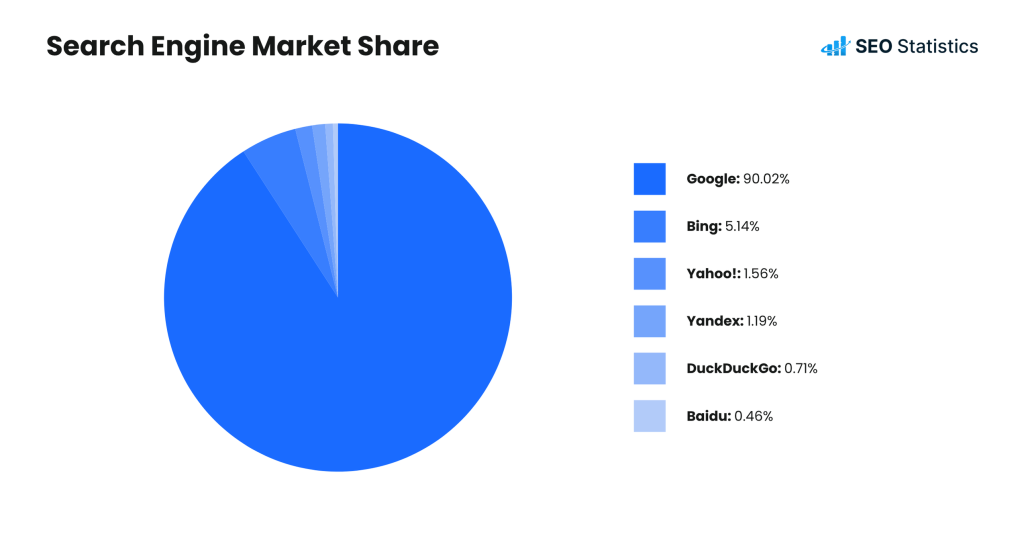
Google holds 90.02% of the global all-device search market, with Bing at 5.14% and Yahoo at 1.5%. Yandex sits at roughly 1.19% globally, concentrated in Russia and neighboring regions, and DuckDuckGo holds 0.71%.
Below is the market share of different search engines:
| Search Engine | Market Share (%) |
|---|---|
| 90.02% | |
| Bing | 5.14% |
| Yahoo! | 1.56% |
| Yandex | 1.19% |
| DuckDuckGo | 0.71% |
| Baidu | 0.46% |
Source: Statista
Google processes more than 5 trillion searches annually, which is around 13.7 billion searches per day, which works out to roughly 159,000 searches every second.
Source: Google
SEO Market Size
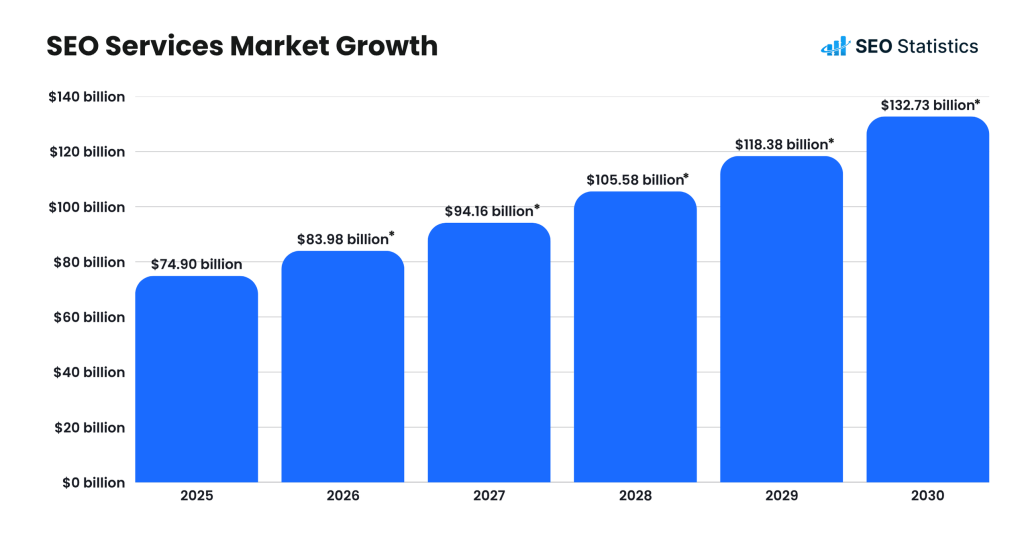
The global SEO services market is expected to grow from $74.9 billion in 2025 to $83.98 billion in 2026, and further expand to $148.86 billion by 2031, at a 12.12% CAGR between 2026 and 2031.
Below is the estimated growth of the SEO services market:
| Year | SEO Services Market Size |
|---|---|
| 2025 | $74.90 billion |
| 2026 | $83.98 billion* |
| 2027 | $94.16 billion* |
| 2028 | $105.58 billion* |
| 2029 | $118.38 billion* |
| 2030 | $132.73 billion* |
| 2031 | $148.86 billion |
*Estimated Figures
Source: Mordor
The SEO software side is comparable in scale.
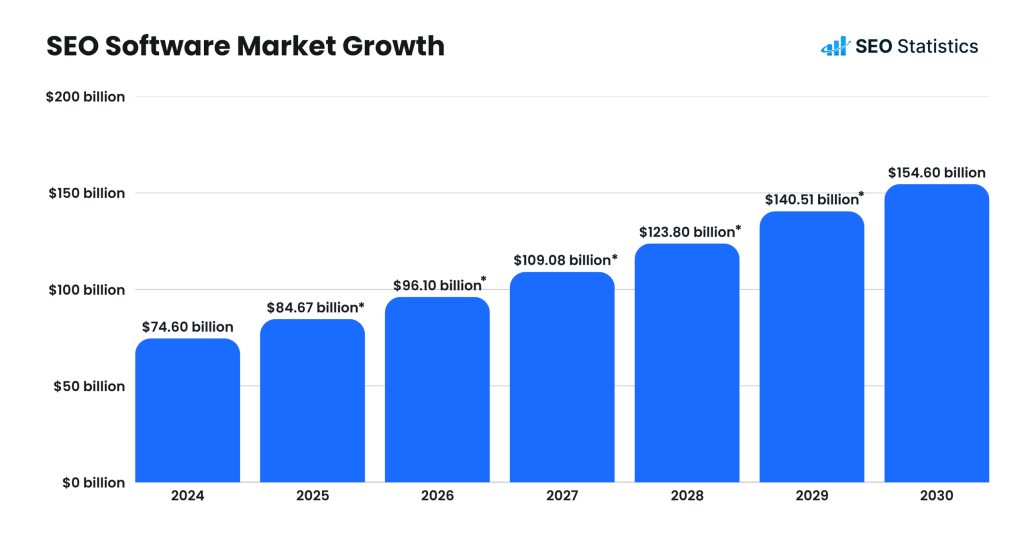
The SEO software market is valued at $74.60 billion in 2024, projected to reach $154.60 billion by 2030 at a 13.5% CAGR.
Below is the estimated growth of the SEO Software market:
| Year | SEO Software Market Size |
|---|---|
| 2024 | $74.60 billion |
| 2025 | $84.67 billion* |
| 2026 | $96.10 billion* |
| 2027 | $109.08 billion* |
| 2028 | $123.80 billion* |
| 2029 | $140.51 billion* |
| 2030 | $154.60 billion |
*Estimated Figures
Source: Grand View Research
Organic Search Traffic Statistics
Organic search is still the largest single source of website traffic on the open web. Organic share of total web traffic stands at 53%.
Source: SEO Inc
SparkToro’s 2026 click-stream analysis found that 68.01% of Google searches now end without a single click to the open web, up from 60.45% in 2024.
Source: Search Engine Land
When AI Overviews are present, the zero-click rate reportedly climbs to 83%. AI Mode queries show an even more extreme 93% zero-click rate.
Source: Digital Applied
Click-through rate by position has compressed sharply. The #1 organic result still captures the largest share, somewhere between 19% and 39.8% depending on whether an AI Overview is present, but position 1 CTR has dropped roughly 32% year-over-year on queries where AI features appear.
Source: Biziq, Try Decoding
Here’s how CTR varies on page 1 of Google search:
| Google Search Feature | CTR |
|---|---|
| Ad Position 1 | 2.10% |
| Ad Position 2 | 1.40% |
| Ad Position 3 | 1.30% |
| Ad Position 4 | 1.10% |
| Search Position 1 | 39.80% |
| Search Position 2 | 18.70% |
| Search Position 3 | 10.20% |
| Search Position 4 | 7.20% |
| Search Position 5 | 5.10% |
| Search Position 6 | 4.40% |
| Search Position 7 | 3.00% |
| Search Position 8 | 2.10% |
| Search Position 9 | 1.90% |
| Search Position 10 (if present) | 1.60% |
Source: First Page Sage
Featured snippets attract the highest click-through rates on Google, receiving 42.9% of clicks when ranked first, slightly outperforming AI Overviews (38.9%) and the #1 organic result (39.8%).
Traditional SERP features such as ads, knowledge panels, and People Also Ask boxes generate relatively low engagement, with CTRs generally below 3% compared to nearly 40% for top organic and featured results.
The average click-through rate (CTR) for each element on a Google Search results page is given below:
| Google SERP Feature | CTR |
|---|---|
| Snippet | 42.9% (1st) 27.4% (2nd) |
| AI Overviews | 38.9% (1st) 29.5% (2nd) |
| #1 Organic Result | 39.80% |
| Ad Result | 1.2-2.1% |
| Image Result | 1.4%-4.9% |
| Video Result | 2.3%-6.4% |
| “People Also Ask” Box | 3.00% |
| Knowledge Panel | 1.40% |
Source: First Page Sage
On the same queries, Seer Interactive’s panel of 53 brands and 5.47 million tracked queries found organic CTR fell from 1.76% to 0.61%, a 61% decline, before partially rebounding in early 2026.
Source: Search Engine Land
Keyword SEO Statistics
Long-tail keywords account for 91.8% of all search queries, while estimates suggest that 95% of all keywords receive fewer than 10 searches per month, with only 0.001% surpassing 100,000 monthly searches.
Source: Backlinko, Ahrefs
That long tail is where conversion lives. Long-tail keywords convert at roughly 2.5x the rate of short-tail terms, and 56% of buyers use queries of three or more words versus only 7% who use single-word searches.
Source: Conductor, Wordstream
Roughly 8% of all searches are phrased as questions, which is part of why structured Q&A and FAQ formatting has become a baseline tactic for both classic SEO and AI citation.
Source: SEOCopilot
Search intent breaks down as 52.65% informational, 32.15% navigational, 14.51% commercial, and 0.69% transactional.
Branded terms account for over 44% of all Google searches, which is one reason brand visibility on AI surfaces has become so consequential. The brand searches that follow an AI mention are often where the actual conversion happens.
And 15% of Google’s daily searches have never been searched before, a number that has stayed remarkably steady for years.
Source: Growth Navigate, WP Beginner
Backlink Statistics
Backlinks remain a top-three ranking signal in Google’s algorithm alongside content quality and user experience, and they appear to influence AI citation patterns as well.
The #1 organic result has 3.8x more backlinks on average than positions 2 through 10, and 92.3% of the top 100 ranking websites have at least one external backlink.
Source: Backlinko, Semrush
The supply side is starkly skewed. 66.31% of all pages have zero backlinks, and 94% of all content attracts no external links.
Source: Ahrefs
Only 2.2% of content earns links from multiple referring domains, meaning that even a small number of quality links places a page ahead of most competitors. Pages with at least one backlink perform 10x better in organic search than pages without.
Source: Searchlab
Pricing and tactics have shifted. The average acceptable price for a single high-quality backlink is $508.95.
Source: Editorial Link
Digital PR has overtaken guest posting as the highest-rated tactic: 48.6% of professionals rate Digital PR as the most effective approach, compared to 16% for guest posting.
Source: Linkbuilding HQ
Mobile SEO Statistics
Mobile is no longer the future of search; it is most of the search. Mobile devices now generate 64% of global web traffic, with that share projected to rise to roughly 70% by the end of the year.
Source: Scalify
Regional variation is significant. Asia leads at 72.3% mobile traffic share, Africa sits at 69.8%, and Oceania trails at 45.5%.
| Region | Mobile Traffic Share | Desktop Traffic Share |
|---|---|---|
| Asia | 72.3% | 27.7% |
| Africa | 69.8% | 30.2% |
| South America | 62.1% | 37.9% |
| North America | 57.0% | 43.0% |
| Europe | 55.0% | 45.0% |
| Oceania | 45.5% | 54.5% |
Source: theStacc
Performance still matters disproportionately on mobile. 53% of mobile website visitors leave if a page takes more than three seconds to load.
Conversion economics, however, still favors the desktop. Desktop converts at roughly 4.3% versus 2.2% on mobile, even though mobile drives the larger share of traffic. Mobile commerce now represents 59% of all retail e-commerce sales globally, with that figure projected to climb to 63% by 2028.
Source: Stacc
Local SEO Statistics
46% of all Google searches have local intent, which means roughly 6.3 billion of Google’s 13.7 billion daily queries involve someone looking for something nearby. “Near me” searches now exceed 200 million per month, and keyword variations for “near me” carry a combined monthly search volume of 7.1 million according to 2026 Semrush data.
76% of people who perform a near-me search visit a business within 24 hours, making local search the fastest search-to-action channel in digital marketing. 28% of local searches result in a purchase, and 88% of consumers who conduct a local search on their phone call or visit a business within 24 hours.
Source: Sales Genie, BrightLocal
Below is how local searches convert into real-world actions:
| Local Search Behavior | Percentage |
|---|---|
| Searches with local intent | 46% |
| Near-me searchers visiting a business within 24 hours | 76% |
| Local searches resulting in a same-day purchase | 28% |
| Mobile local searchers calling or visiting within 24 hours | 88% |
| Mobile users contacting businesses directly from search results | 60% |
| Consumers searching online for local businesses | 98% |
Source: Google, BrightLocal, Wiser Review
Local Reviews and Trust Signals
97% of consumers read reviews for local businesses, and 41% of consumers now say they always read reviews before choosing a local business, up from 29% the year before.
86% of consumers use Google as their primary platform for reading local business reviews. There is a nearly 3% lift in Google Business Profile conversions for every 10 new reviews, and 65% of respondents say they are more likely to choose businesses that engage with reviews by leaving responses.
Local SEO Market Size
The local SEO software market is valued at $10.34 billion in 2026 and is projected to reach $19.36 billion by 2031 at a 13.37% CAGR.
Source: Mordor Intelligence
Local SEO generates a cost-per-lead roughly 61% lower than traditional outbound marketing, and 94% of high-performing brands run a dedicated local marketing strategy compared to 60% of average performers.
Source: BizIQ, Brand Beacon Report
Below is a summary of local pack ranking factor weights in 2026:
| Ranking Factor Category | Weight |
|---|---|
| Google Business Profile signals (proximity, categories, keyword in title) | 32% |
| On-page signals (NAP, local keywords, domain authority) | 19% |
| Review signals (quantity, velocity, diversity, sentiment) | 16% |
| Link signals (inbound anchor text, domain authority, local links) | 15% |
| Behavioral signals (CTR, mobile clicks-to-call, dwell time) | 8% |
| Citation signals (NAP consistency, citation volume) | 7% |
| Personalization signals (search history, location) | 3% |
Source: Whitespark, Digital Applied
AI SEO Statistics
On the Google side, AI Overviews are now a fixture. AI Overviews appeared on 48% of all tracked search queries as of March 2026, up from 34.5% in December 2025, which is a roughly 58% jump in three months.
Source: Digital Applied
AI Overviews now appear in 200 countries and 40 languages, and queries that include both a noun and a verb trigger an AIO 36% of the time. Searches containing eight or more words are 7x more likely to trigger an AI Overview.
Source: Heroic Rankings
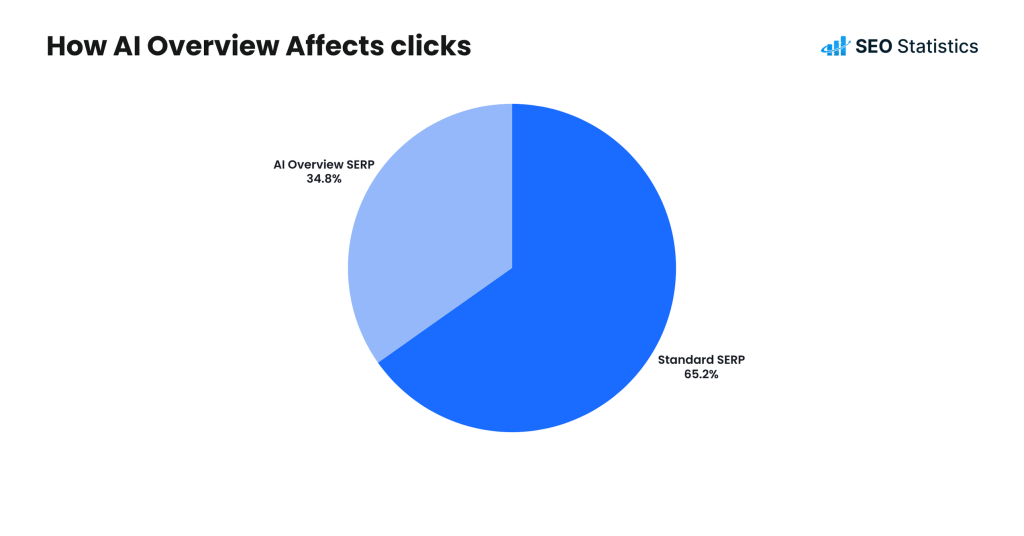
The click impact is real and uneven. Pew Research found that when an AI Overview appears, only 8% of users click any organic result at all, versus 15% on a standard SERP, a single feature cuts click behavior nearly in half.
Source: Pew Research
CTR drops vary by device: desktop CTR can fall by roughly 50%, mobile by about a third.
Source: SEO Profy
But sites cited inside an AI Overview see 35% higher CTR than non-cited competitors on the same query, meaning the difference between being cited and being bypassed has become the defining variable.
Source: Traficxo
AI Search and User Behavior
AI assistants have moved from novelty to daily habit faster than any consumer technology since mobile. ChatGPT crossed a billion monthly active users in around mid 2026, up from around 300 million in December 2024.
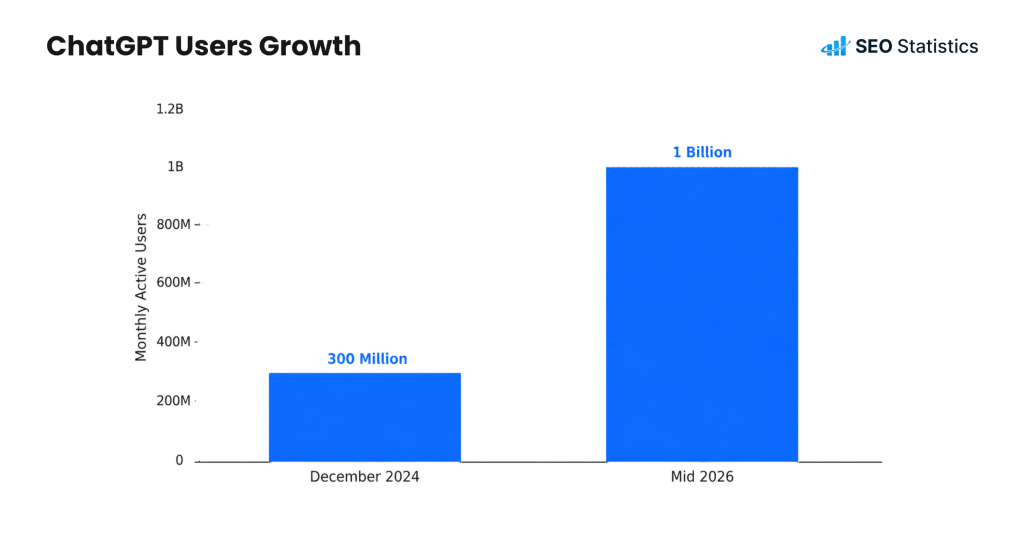
It is now the 5th most visited website globally and holds an 79.05% share of the AI chatbot market.
Source: Instant Press, Exposure Ninja, Statcounter, CNBC
User behavior on AI surfaces looks meaningfully different from Google. 32% of ChatGPT interactions are informational, and 9% are commercial.
Source: Exposure Ninja
The conversion math is the part most marketers miss. AI search traffic converts at 14.2% versus Google’s 2.8%, and visitors referred from AI assistants convert at roughly 4.4x the rate of Google visitors.
Source: Superprompt
Volume is still tiny by comparison. Google sends 345x more traffic than the top three AI engines combined, but the quality of an AI-referred visit is materially higher because the assistant has already pre-qualified the user.
Source: Keyword
31% of Gen Z now use AI platforms or chatbots as their primary method for finding information online, 41% of Gen Z use social platforms as their primary search engine, and 66% of consumers believe AI will replace traditional search within five years.
Source: Sprout Social, Hubspot, FastSpring
AI Content Statistics
AI-generated content is no longer a niche tactic. 74.2% of newly created web pages contain AI-generated content, though only 2.5% are pure AI; the vast majority are human-AI blends.
97% of content marketers plan to use AI for content creation in 2026, up from 90% in 2025.
Source: Ahrefs, LinkedIn
Adoption among marketers is near-universal. 94% of marketers plan to use AI in content creation in 2026, and 88% already use AI in their day-to-day roles.
Average AI marketing spend has grown from $6.46 billion in 2018 to $57.99 billion in 2026, a 37.2% CAGR.
Output gains are significant. 84% of marketers say AI improved the speed of content delivery.
Source: Arvow
Also, companies using AI in marketing see 22% higher ROI and 32% more conversions.
Source: BizIQ
AI Search Engine Optimization Trends
A few patterns have stabilized. First, citation matters more than ranking. 52% of sources cited in Google AI Overviews already rank in the top 10 organic results for the same query, meaning classic SEO and AI citation overlap heavily but not entirely.
Source: Search Engine Journal
Second, third-party mentions are now a leading citation signal: brands are 6.5x more likely to be cited by AI through third-party sources than through their own pages, which has elevated digital PR from a tactic to a core GEO discipline.
Source: Search Engine Land
Third, marketers are starting to budget for it explicitly. 25.7% of marketers now plan to develop content specifically for AI citations, and 30% of marketers report decreased search traffic as users shift to AI tools, driving budget reallocation toward AI visibility work.
Source: Digitaloft, Arvow
Topic targeting is replacing keyword targeting in GEO frameworks, since LLMs reason over concepts rather than exact phrases, and brand mention frequency is becoming a more important signal than backlink count alone.
Source: SEO
SEO Investment and ROI Statistics
SEO returns on investment are not uniform across sectors, as they depend heavily on factors like customer lifetime value and how long it takes to convert a lead into a sale.
This is largely because these sectors involve high-value customers and ongoing relationships, so even small improvements in organic search visibility can translate into significant revenue growth over time.
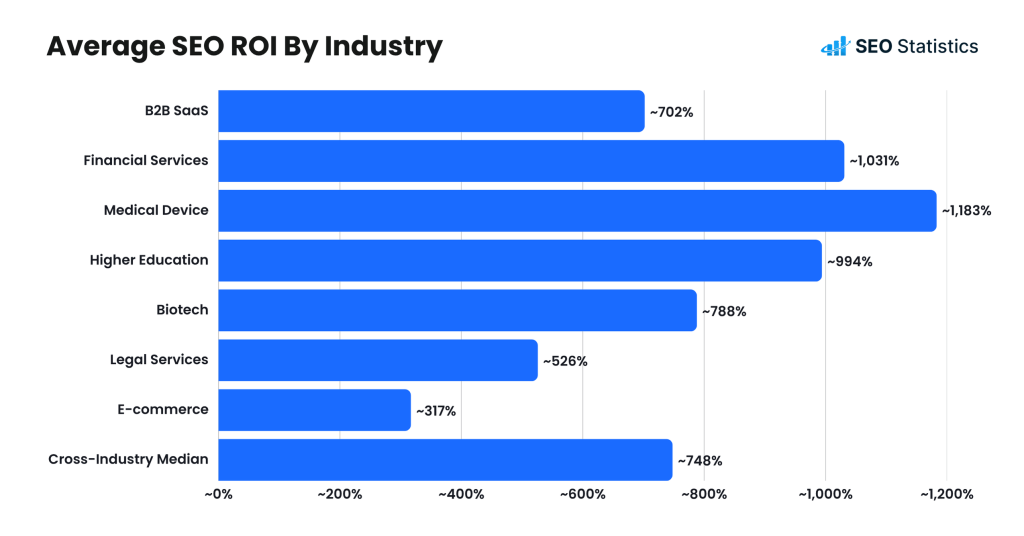
| Industry | Average SEO ROI | Break-Even Timeline |
|---|---|---|
| B2B SaaS | ~702% | ~7 months |
| Financial Services | ~1,031% | 12-18 months |
| Medical Device | ~1,183% | 12-24 months |
| Higher Education | ~994% | 12-24 months |
| Biotech | ~788% | 12-24 months |
| Legal Services | ~526% | 9-12 months |
| E-commerce | ~317% | 12 months+ |
| Cross-Industry Median | ~748% | 6-12 months |
Source: SEO Profy
Future of SEO
First, zero-click is becoming the default. The share of searches generating at least one click fell 9.51 percentage points between 2024 and 2026, a 22.9% relative decline.
Source: Search Engine Land
US organic search traffic was down 2.5% year-over-year as of early 2026, a real decline, but well short of the 25% to 50% collapse some predicted. The bigger shift is that the searches that do click increasingly land on AI-cited sources and high-intent transactional queries.
Source: Digital Bloom
Second, AI visibility is becoming a parallel discipline to SEO rather than a replacement. Google still processes an estimated 14 billion daily queries to ChatGPT’s roughly 37.5 million, a ratio of 373:1.
The traffic from AI is small but higher-converting, and brands that get cited inside AI Overviews see brand search lift in subsequent days, even when the AI session itself produced no clicks.
Source: Search Engine Journal
Third, E-E-A-T signals are becoming continuous rather than static. Author schema, named credentials, primary research citations, and DA 60+ third-party mentions are increasingly treated as live signals by both Google quality systems and AI citation algorithms.